
The Complete Pre-Arrival Guide for International Students
Blocked account, uni-assist, visa, health insurance and your first 30 days — every step explained at official 2026 rates, with free printable checklists.
 Brandenburg Gate, Berlin · Thomas Wolf, foto-tw.de / CC BY-SA 3.0
 To start a degree in Germany in 2026/27 you need five things: a qualification Germany recognises (check it in Anabin), a language certificate (IELTS/TOEFL for English-taught programs, TestDaF/DSH for German-taught), an application — usually via uni-assist (€75 first program, €30 each additional), proof of funds of €11,904 in a blocked account, and statutory health insurance (≈€140/month) plus a national D visa. Public universities charge no tuition — the only exception is Baden-Württemberg (€1,500/semester for non-EU students).
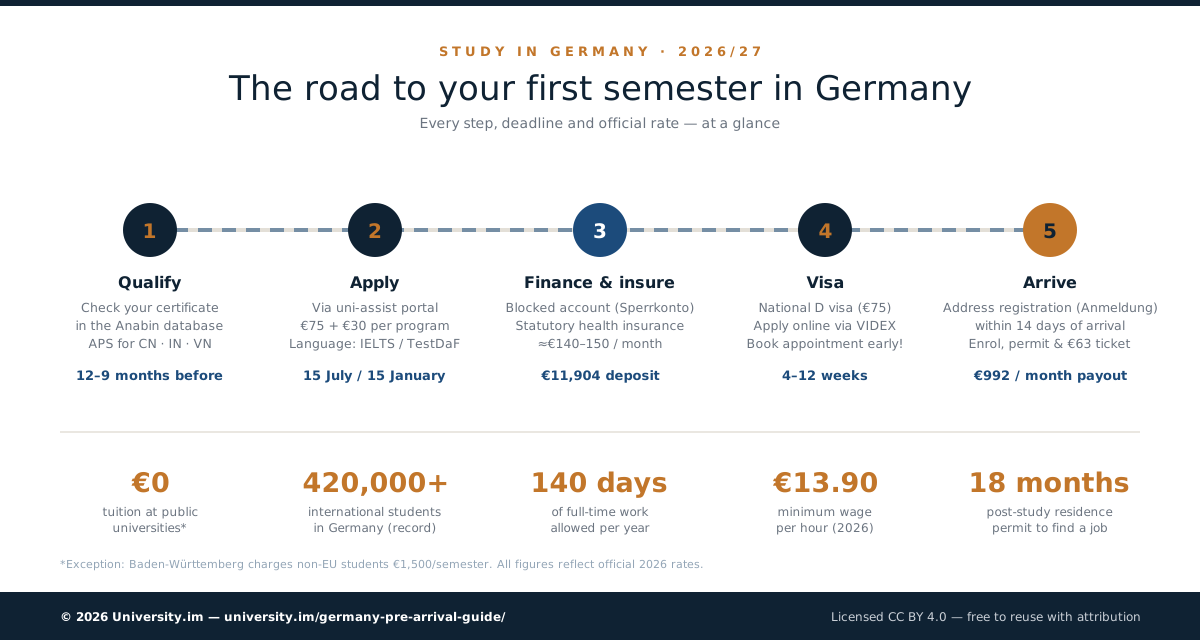
Germany has become the quiet winner among study destinations. While the USA refused 35% of F-1 student visas in 2025 and Canada rejected roughly two thirds of study permits, Germany keeps growing — the DAAD counts well over 400,000 international students, with India (≈59,000) now the largest group.
The reasons are simple: no tuition at public universities, English-taught Master’s programs, strong engineering schools and a clear path to staying after graduation. But the German system has its own logic — uni-assist, Anabin, Sperrkonto, Anmeldung. This guide explains the entire journey in plain English, from first research to your first 30 days in the country.
Annual tuition for international students
Ranges from our 30-country cost-of-study database. Germany: no tuition at public universities except Baden-Württemberg (€1,500/semester); a semester fee of €100–400 applies everywhere.
Your 12-month timeline
Work backwards from the semester you want to start.
- 12–9 MONTHS Shortlist programs, check your qualification in Anabin, find out whether you need an APS certificate (China, India, Vietnam), start language preparation.
- 9–6 MONTHS Take your language test, collect transcripts, obtain certified copies and sworn translations, apply for APS if required.
- 6–3 MONTHS Submit applications. Classic deadlines are 15 July for the winter semester and 15 January for the summer semester at many public universities.
- 3–1 MONTHS After admission: open the blocked account, arrange health insurance, book the visa appointment immediately, join housing waiting lists.
- ARRIVAL Register your address within 14 days, activate the blocked account, enrol, collect your residence permit.
Check that you qualify
German universities decide admission on your Hochschulzugangsberechtigung — the higher-education entrance qualification. Whether your certificate or degree qualifies is documented in Anabin, the official database of the German education ministries. Three outcomes are possible.
Grades matter. German universities convert your GPA with the Modified Bavarian Formula — many Master’s programs expect a converted grade of 2.5 or better.
Language requirements
Germany runs two parallel systems, and the one that applies depends entirely on the language your program is taught in.
Even in an English-taught program, everyday life, part-time jobs and the later job market reward German skills — reach A1/A2 before you arrive if you can.
 University library · Gary Todd / CC0
 Apply — uni-assist, deadlines & fees
Many German universities outsource international admissions to uni-assist, which checks documents and converts grades. Others accept direct applications — always check the university’s own admission page first.
| Item | Detail (2026) |
|---|---|
| Handling fee | €75 for the first program, €30 for each additional one per semester |
| Winter deadline | 15 July at many public universities; some earlier — check each program |
| Summer deadline | 15 January |
| VPD | Some universities want uni-assist’s preliminary review document first — request it early, processing takes weeks |
| Document set | Certified certificates and transcripts, sworn translations, language certificate, passport copy, CV, motivation letter, APS certificate if applicable |
Proof of funds — the blocked account
For the visa you must prove you can finance one year of living costs. The standard route is a Sperrkonto: you deposit the full amount before the visa application and withdraw a fixed sum each month after arrival. Providers such as Expatrio, Fintiba and Coracle open these accounts online.
€992 per month is the legal minimum, not a comfort guarantee. In Munich, Frankfurt or Hamburg a room alone often costs €600–800. Budget honestly before you choose a city — Leipzig, Chemnitz or Magdeburg leave far more breathing room.
What a month really costs
In Munich or Frankfurt, rent alone can swallow 70% of the €992 payout.
Health insurance
Health insurance is mandatory for enrolment and for the visa. Students under 30 join the statutory system (TK, AOK, Barmer and others) at the student rate of roughly €140–150 per month including long-term care insurance. All statutory insurers cover the same core services by law. Students aged 30 or older at enrolment usually need private or voluntary statutory coverage — compare carefully before arrival.
The student visa
Non-EU citizens need a national visa (type D). The form is filled in online via the official VIDEX portal and submitted at the German mission in your country. EU/EEA citizens need no visa; citizens of the USA, UK, Canada, Australia, Japan, South Korea and a few others may enter visa-free and apply for the residence permit after arrival.
Housing — start early, beware of scams
 RWTH Aachen · א (Aleph) / Wikimedia Commons, CC BY-SA 2.5
 Housing is the hardest part of moving to Germany. Average student rents across 38 university cities sit around €490–550; Munich tops €700. Student halls are the cheapest option, but waiting lists in Munich, Berlin, Hamburg and Heidelberg run into the thousands at semester start.
- 01Register with the local Studentenwerk waiting list the day your admission letter arrives.
- 02Search WG portals in parallel. Treat any landlord demanding money before a viewing or video call as a scam.
- 03Never transfer a deposit via Western Union or crypto. A legitimate Kaution is 2–3 months’ basic rent, paid after the contract is signed.
Your first 30 days in Germany
Seven administrative steps, roughly in this order.
Free downloads
Three printable tools, free for personal use. Universities and student advisors are welcome to share them.
Frequently asked questions
How much money do I need to study in Germany?+
For the visa: €11,904 in a blocked account (2026). Realistically, students spend €950–1,250 per month depending on the city — rent is the deciding factor. Add one-time costs of roughly €500–1,000 for semester fee, deposits, visa and translations.
Is university really free in Germany?+
Public universities charge no tuition for most programs — you pay only a semester fee of €100–400. The exception: Baden-Württemberg charges non-EU students €1,500 per semester. Private universities charge €5,000–20,000+ per year.
Do I need to speak German to study in Germany?+
Not for admission to English-taught programs, which dominate international Master’s degrees. German-taught programs require TestDaF or DSH-2. Everyday life and part-time jobs are much easier with basic German.
How long does the student visa take?+
Plan for several weeks up to three months, depending on the embassy. The appointment wait is usually the bottleneck — book as early as possible, in high-volume countries even before your admission letter arrives.
Can I work while studying?+
Yes: 140 full days or 280 half days per year since the 2026 summer semester, at a minimum wage of €13.90/hour — roughly a 20-hour week during term time.
Can I stay after graduating?+
Yes. Graduates of German universities receive an 18-month residence permit to look for a job, and switch to a work permit or EU Blue Card once employed — one of Germany’s biggest advantages over other destinations.
Sources & official links
All amounts reflect official 2026 rates (blocked account, minimum wage, Deutschlandticket, broadcasting fee). Last updated September 2026. Cite as: University.im Editorial Team (2026), Study in Germany: The Complete Pre-Arrival Guide 2026/27.